



Servicios Personalizados
Revista

Articulo
 Inglés (pdf)
 Articulo en XML
 Referencias del artículo
 Traducción automática
 Enviar articulo por email
Indicadores
-
 Citado por SciELO
Links relacionados
-
 Similares en
SciELO
Similares en
SciELO
Compartir

 Permalink
Revista de la Unión Matemática Argentina
versión impresa ISSN 0041-6932versión On-line ISSN 1669-9637
Rev. Unión Mat. Argent. v.48 n.2 Bahía Blanca jul./dic. 2007
Group actions on algebras and module categories
J. A. de la Peña
Introduction and notations
Let  be a field and
  a finite dimensional (associative with
  )
)  -algebra. By
  we denote the category of finite dimensional left
  -modules. In many important situations we may suppose that
  is presented as a quiver with relations
  (e.g. if
  is algebraically closed, then
  is Morita equivalent to
  ). We recall that if
  is presented by
  , then
  is a finite quiver and
  is an admissible ideal of the path algebra
  , that is,
  for some
  , where
  is the ideal of
  generated by the arrows of
  , see [6].
It is convenient to consider  as a
as a  -linear category with objects
  (= vertices of
  ) and morphisms given by linear maps
  , where
  is the trivial path at
  (for
(for  ). In this categorical approach we do not need to assume that
  is finite (therefore the
  -algebra
  may not have unity). Ocasionally we write
  if we do not need to explicit the quiver
  .
.
The purpose of these notes is to present an introduction to the study of actions of groups on algebras  and their module categories
  and to consider associated constructions that have proved useful in the Representation Theory of Algebras.
A symmetry of the quiver  is a permutation of the set of vertices
  inducing an automorphism of
  . We denote by
  the group of all symmetries of
  . Those symmetries
  inducing a morphism
  such that
  form the group
  . In natural way, any
  induces an automorphism of the module category
  and on the Auslander-Reiten quiver
  of
of  (since the action commutes with the Auslander-Reiten translation
  of
of  ).
).
In section 1, we present some basic facts about the actions of groups  on
on  (orbits, stabilizers, Burnside's lemma) and show that for a representation-finite standard algebra
  , we have
  , where
  is formed by the symmetris of
  commuting with the translation
  . We recall that
  is standard if
  is representation-finite and for a choice of representatives of the isoclasses of indecomposables, the induced full subcategory of
  (denoted by
  ) is equivalent to
  which is the quotient of the path algebra
  by the ideal generated by the meshes
  of the almost split sequences
  . We recall that for
  , any representation-finite algebra
  is standard.
In section 2 we consider relations between the structure of  and the Coxeter polynomial of
  (recall that,
  is the Coxeter polynomial associated to the Coxeter matrix
  which is
  -invertible in case
  ).
).
In section 3 we present the main constructions associated to groups acting on algebras:
 if
if  acts freely on
  (that is,
  and
and  for a vertex
  , implies
  ), then the Galois covering
  is a
is a  -invariant functor of
  -categories.
 if
if  is a
is a  -graded
  -category, the smash product
  is a
is a  -category accepting the free action of
  . Moreover,
  .
.
Galois coverings were introduced by Bongartz and Gabriel [6, 7, 2] for the study of representation type of algebras. Smash products is a well-known construction in ring theory (see [1]), but only recently was observed by Cibils and Marcos [4] that it yields the inverse operation to Galois coverings. Indeed, if  acts freely on
  , then
  is a
is a  -graded category such that
  .
.
In section 4, following [2], we introduce functors relating the module categories of  and
and  when
when  acts freely on
  . The main results in these notes (section 5) relate the representation types of
  and
and  (which was the original purpose of the introduction of Galois coverings). Indeed, given a Galois covering
  with
with  a finite dimensional
  -algebra, then
  is representation-finite if and only if
  is locally representation-finite (that is, for each
  , there are only finitely many indecomposable
  -modules
  , up to isomorphism, with
  ). The proof of this result was partially given in [7] and completed in [10], and provides an efficient tool to deal with representation-finite algebras.
The representation-infinite situation is more involved. We recall that  is said to be tame if for every
  there are finitely many
 ![A - k[t]](/img/revistas/ruma/v48n2/2a02114x.png) -bimodules
-bimodules  wich are free finitely generated as right
 ![k[t]](/img/revistas/ruma/v48n2/2a02116x.png) -modules and such that any indecomposable
-modules and such that any indecomposable  -module
  with dimension
  is of the form
 ![Mi ⊗k [t] (k[t]∕(t - λ))](/img/revistas/ruma/v48n2/2a02120x.png) for some
for some  and some
  . We say that a tame algebra
  is domestic (resp. of polynomial growth) if
  can be chosen
  (resp.
  for some
  ) for all
  . It is not hard to show that
  is tame if
  is tame for a group acting freely on
  . The converse was shown to be false in [8]; nevertheless there are many interesting, general situations where it holds true.
In section 5 we give examples of results [5, 12] showing that for a Galois covering  , the category
  is tame if and only if
  is tame, provided certain restrictions on the group
  or on the category
  are satisfied.
We denote by  the Grothendieck group of
  , freely generated by representatives
  of the simple
  -modules, where
  is the number of vertices of
  . We denote
  (resp.
  ) the projective cover (resp. injective envelope) of
  . With the categorical approach an
  -module is a functor
  , and a morphism
  is a natural transformation. In case
  , the Coxeter matrix
  is defined by
 ![φ ([P ]) = - [I] A i i](/img/revistas/ruma/v48n2/2a02151x.png) .
.
These notes follow closely the lectures given at the Workshop on Representation Theory in Mar del Plata, Argentina in March 2006. The intention of the lectures was to present an elementary introduction to the topic which would serve as a source of motivation and information on the techniques used. While we cannot provide complete proofs of every result, we tried to sketch some representative arguments. We thank the organizers of the Workshop for his hospitality.
1. The group of automorphisms of an algebra
1.1. Let  be a finite dimensional
  -algebra:
 denotes the group of automorphisms of
  . By
. By  we denote the group of symmetries of
  and by
  the group of symmetries of
  fixing
  (that is,
  induces
  such that
  ).
).
- Lemma.
 is a subgroup of
  .
. 
Each symmetry  gives rise to a matrix
  sending
  to
to  . This representation
  is called the canonical representation.
1.2. Let  be a subgroup. For a given
  ,
,  denotes the orbit of
  and subgroup of
  ,
,  denotes the stabilizer of
  . Clearly
  is a subgroup of
  .
.
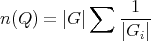
- Lemma.
- The mapping
 ,
,  is a bijection from the orbit to the set of left cosets
  .
. 

1.3. Let  be the Grothendieck group of
  . Consider

 -space of
  -invariant vectors. Then
  the number of orbits of
  in
in  equals
  .
. Let  be a set of representatives of the irreducible
  -representations of
  (here
(here  is the number of conjugacy classes of
  ). Let
  be the trivial representation.
Consider  the character corresponding to
  (that is,
  ,
,  ). The characters
  form an orthonormal basis of the class group
  , with the scalar product
  .
.
- Lemma.
- [Burnside's lemma].
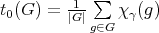 where
where  , is the character of the canonical representation
  .
.
Proof. Observe that  is the number of fixed points of
  .
.

 . □
. □ 1.4. Let  be a subgroup of
  then
then  acts on
  as follows:

 , we have
  . Similarly, for
  , we define
  .
. Clearly, this action preserves indecomposable modules and induces an action of  of the Auslander-Reiten quiver
  , satisfying:
- the action preserves projective, injective and simple modules;
- the action preserves Auslander-Reiten sequences (in particular,
 );
);  is a subgroup of
  , the group of automorphisms of the quiver
  (commuting with the
  -structure).
For (c), let  be an element inducing a trivial action on
  ; we shall prove
  . Indeed,
  implies
  for every vertex
  .
.
Let  ,
,  be all arrows between
  and
and  , then
  establishes a permutation of the
  . Let
. Let  be the
  dimensional
  -module with
  . Since
  is indecomposable,
  or
or  . Therefore
  .
.
- Proposition.
- Let
 be an algebra satisfying:
 (a)
 is representation finite, (b)
  is standard
then
 .
.
Proof. We already know that  is a subgroup of
  . Let
. Let  and consider the induced automorphism
  of the mesh category
  . Clearly,
  restricts to an automorphism of
  (considering the full embedding
  ,
,  ). By definition there is an automorphism
  inducing
  , and therefore inducing
  . □
. □
2. The canonical representation and the Coxeter matrix
2.1. Let  and assume that
  . For example, this happens if
  is triangular, that is,
  has no oriented cycles.
Recall that  ,
,  is the Coxeter matrix if
  , which is
  -invertible. In case
  (i.e.
(i.e.  ), then
  for any non-projective indecomposable
  .
.
The characteristic polynomial  is called the Coxeter polynomial.
- Examples:
-
 Dynkin type, then
  .
. extended Dynkin type, then
  and
and  is a root of multiplicity
  .
.
 is irreducible (over
 ![ℤ [t]](/img/revistas/ruma/v48n2/2a02289x.png) ).
).
- Proposition [11].
-
 is an automorphism of the representation
  .
.- If
 is not trivial, then
  is not irreducible.
Proof. (a): It suffices to observe that  for any
  .
.
(b): Let  be a set of representatives of the irreducible
  -representations of
  . Let
. Let  be the trivial representation. Up to conjugation (with
  )
)
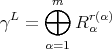
 , then
 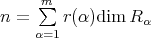 .
. By Schur's lemma 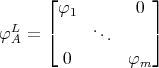 , where
  is an automorphism. Hence
  . Therefore if
  is irreducible then
  for
for  .
.
If  , then
  . Moreover, the characters

 with scalar product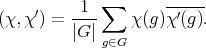

 ,
,  .
. Finally,  , with implies the existence of
  with
with  . Therefore
  is not irreducible. □

Consider  and
and  the canonical representation. It is not hard to calculate the character table of
  :
:
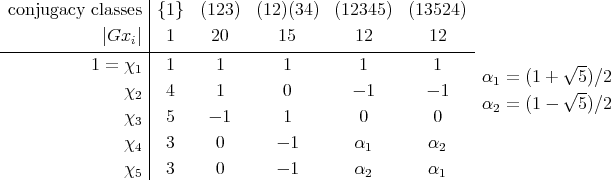
 corresponds to
  irreducible
  -representation of
  (with
(with  the trivial representation).
Then
![⊕ s γT = Snβ(β), n(1) = t0(G ) = 2 β=1 1 ∑ ------ 1 n(2) = (χ γ,χ2) = --- χγ(g)χ2(g) = --[24 + 60 - 24] = 1 60 g∈G 60](/img/revistas/ruma/v48n2/2a02332x.png)
 ,
,  which is also a
  -decomposition. Moreover,
  is an irreducible factorization.
 3. Constructions of algebras asociated to groups of automorphisms (coverings and smash products)
3.1. Let  be a
be a  -category given as
  . Let
. Let  be a subgroup of
  . We say that
  acts freely on
  if
if  for some
  implies
  .
.
- Lemma.
- Let
 be a group acting freely on
  . Then there exists a
  -category
  and a functor
  satisfying:
 - (
 -invariant):
  for every
- (universal
 -invariant): for any functor
  which is
  -invariant, there exists a unique functor
  such that
 is formed by the
  -orbits of vertices in
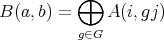
  and for any
  and
and 
- (
Proof. Let  be defined as in (c) with composition maps

 ,
,  in the unique possible way (since
  implies
  ). □
). □ 3.2. If  acts freely on
  , the functor
  as in (2.1) is called a Galois covering defined by
  and
and  is a Galois quotient of
  .
.
We say that a  -category
  is
is  -graded if for each pair of objects
  there is a vector space decomposition
  such that the composition induces linear maps

- Lemma.
 is a
is a  -graded
  -category.
3.3. For a  -graded
  -category
  we define the smash product as the
  -category
  with objects
  and for any pair
  , the morphisms are


- Theorem
- [4]. The category
 accepts a free action of
  such that
  .
. Moreover, if
 acts freely on
  , then
  .
.
Proof. Clearly there is a  -invariant functor
  inducing a functor
  which is the identity on objects. Check that
  is an isomorphism.
Assume  acts freely on
  and let
  be the induced Galois covering.
Since  acts freely, there is a bijection
 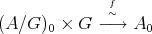 which commutes with the
  -action. Moreover, if
  ,
,  ,
,  then
then

In other words, smash products and Galois quotients are inverse operations in the class of  -categories.
3.4. Galois correspondence. Let  be a
be a  -category. There is a
  correspondence
( Galois covering defined by
  )
)  group grading
  , such that for any
two Galois coverings  defined by
  and
and  defined by
  , there exist a commutative diagram

 , such that
  .
. A Galois triple  of
of  is a Galois covering
  defined by the (free) action of a group
  . There is a universal object in this set of Galois triples. Indeed, let
  and consider
  the set of all walks in
  starting and ending at a fixed vertex
  . Let
. Let  be the equivalence relation induced by the following elementary relations:
 and
and  for any arrow
  ;
;- if
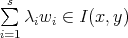 with
with  , such that for any
  we have
 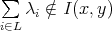 , then
  for
for  ;
; - if
 , then
  , whenever the products are defined.
Then  has a group structure such that
  is
is  -graded. The group
  is called the fundamental group of
  .
.
- Proposition
- [9]. Let
 and
and  be defined by
  . The triple
  is a universal Galois covering, that is, for any Galois covering
  defined by the action of a group
  , there exists a covering
  defined by
  such that
  .
. 
4. Actions induced on module categories
4.1. Let  be a Galois covering of
  -categories defined by the action of
  . We shall denote by
 the category of left
  -modules;
 those
those  with
with  for every
  ;
; those
those  with
with 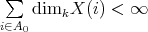 .
.
There are naturally defined functors:


 , then
  , sends
  to
to 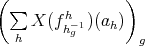 , called the push-down functor. We observe that
  is a left adjoint to
  . Similarly, there is a right adjoint
  to
to  . For modules
  , the modules
  and
and  coincide.
 Recall that  acts on
  and
and  is
is  -stable if
  for every
  . The category of
  -stable
  -modules is denoted by
  .
.
4.2. Proposition [7, 2]. Let  be a Galois covering defined by the action of
  . Then the following happens:
- The categories
 and
and  are equivalent.
 - For any
 and
and  , we have
  . Moreover,
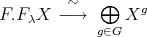 as
as  -modules.
 - Let
 be a subgroup of
  and
and  . Then
  has a natural structure as
  -module. If
  is a finite group and
  , then
  decomposes as a direct sum of at least
  factors.
Proof. (a): clear.
(b): Observe that  canonically.
Hence  and correspondingly in morphisms.
(c): Choose a set  of representatives in
  of the right cosets
  . Then
  and correspondingly in morphisms.
Hence we get  a group homomorphism such that for each idempotent
  of
of  ,
,  is idempotent and there is a factorization of
  .
.
In case  is a finite group with
  , by Mashké theorem, the group algebra
  is semisimple (with
  idempotents). The result follows. □
4.3. Assume  acts freely on
  and
and  is the corresponding Galois covering.
Let  , the stabilizer
  is the subgroup of
  formed by those
  such that
  . That is,
  if
if  .
.
- Proposition [7].
-
- If
 and
and  is torsion free, then
  .
. - If
 and
and  , then
  is indecomposable and for any module
  with
with  , then
  for some
  .
.
- If
Proof. (a): Let  for some
  , then
  establishes a permutation of
  (a finite set). Then for some
  ,
,  on
on  . Since
  acts freely on
  , then
  . Since
  is torsion free, then
  and
and  .
.
(b): Assume  , then
  . Assume
  is a direct summand of
  , then
 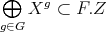 and
and  . Therefore
  is indecomposable.
If  , then
  is indecomposable and
  for some
  . □
. □
5. Coverings and the representation type of an algebra
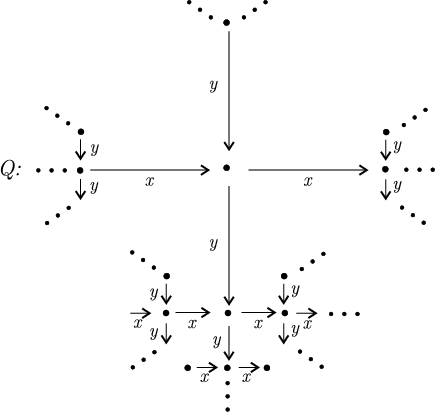
(a) Let 
Let  be the infinite
  -category with quiver
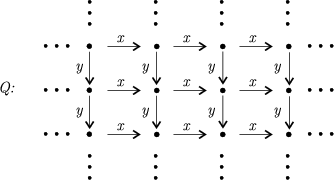
and  generated by all relations of the form
  . Then we get a Galois covering
  defined by the action of
  on
on  .
.
The module
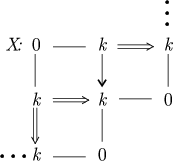
It is stable under the action of  ,
,  .
.
The universal Galois covering of  is given by
where the free group in two generators  acts on
  . The normal subgroup
  of
of  acts on
  inducing the covering
  .
.
Observe that for  , we have
  and therefore
  .
.
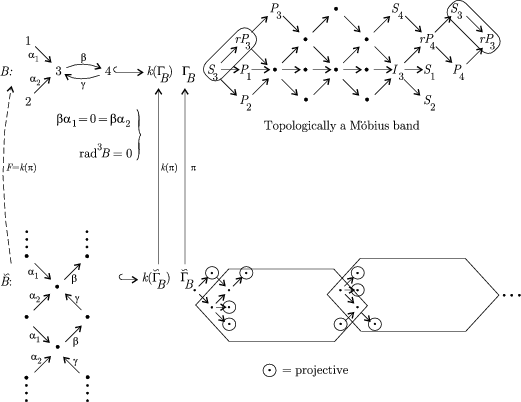
(b) [13] Let  be a standard
  -algebra of finite representation type. Then the Auslander-Reiten quiver
  is finite and equipped with the mesh relations:
 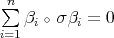 , for each almost split sequence
  .
.
There is an universal Galois cover  of translation quivers defined by the action of a free group
  . Moreover,
  is the Auslander-Reiten quiver of a
  -category
  such that
 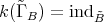 .
.
We illustrate the situation in the following example:
A full subcategory  of
of  is convex in
  if
if  for a quiver
  which is path closed in
  (i.e.
(i.e.  with
with  implies
  ).
).
- Theorem.
- Let
 be a representation-finite
  -algebra. Then
 - [13] There exists a universal Galois covering
 defined by the action of a free group
  . Moreover
 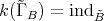 for a
for a  -category
  . If
. If  is standard, then
  is a universal Galois covering.
 - [3] For every finite convex subcategory
 of
of  , we have
  and
and  is representation-directed (i.e.
  is representation-finite and
  is a preprojective component).
- [13] There exists a universal Galois covering
5.2. We say that the group  acts freely on indecomposable classes of
  -modules if
  for
for  implies
  . Observe that for the algebra
  with quiver
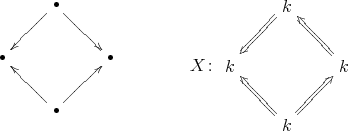
 has non-trivial stabilizer.
 - Theorem.
- Let
 be a Galois covering defined by a group
- [2] If
 acts freely on indecomposable classes of
  -modules, then
  induces an injection (
 and preserves Auslander-Reiten sequences.
 - [2, 10] If
 is finite (hence a
  -algebra), then
  is representation-finite if and only if (i)
  acts freely on
  and (ii)
  is locally representation-finite (i.e. for each
  ,
,  is finite). In that case,
  .
.
- [2] If
Proof. (a): Let  , then we know
  and
and  . Moreover
  implies
  for some
  . For an almost split sequence
  with
with  we get an exact sequence

 ,
,  indecomposable. For
  a non-invertible epi in
  , we get a map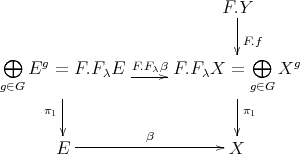
 such that
  . From the adjunction
  we get
 and
and  is almost split sequence in
  .
. (b): Assume  is representation-finite and
  are representatives of
  . Let
. Let  and suppose
  is such that
  . We shall prove that
  . Let
. Let  be a covering defined by a free group
  as in (5.1), that is, we get commutative diagrams:
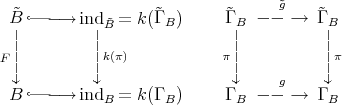
Then  induces an automorphism
  on
on  such that
  and
and  for some
  with
with  . We get an automorphism
  of
of  acting freely (since
  acts freely on
  ).
).
Let  be the full subcategory of
  formed by
  . It is easy to see that
  is convex in
  and therefore
  is a preprojective component. Since
  , then we get
  with
with  . Since
  commutes with
  , there is a projective
  -module
  with
with  , which is a contradiction unless
  .
.
We check that  is locally representation-finite: let
  and let
  be all indecomposable
  -modules which are direct summands of
  for some
  and
and  . This set is finite [indeed,
 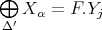 , then
  and
and  , for all
  . Since
  , the set is finite].
Finally, let  . Then
  and
and

 for some
  . Therefore
  . □
. □ 5.3. Let  be a Galois covering with group
  . In case
  is a representation-finite
  -algebra, we have seen that
  covers all indecomposable modules. The situation is different for representation-infinite algebras. We shall briefly discuss the new occuring phenomena. By
  we denote the full subcategory of
  formed by all objects isomorphic to
  for some
  (these modules are called
  -modules of the first kind). The remaining indecomposable modules (called of the second kind) form the category
  .
.
If  is such that
  is not finite but
  is finite, then
  is called a weakly
  -periodic module.
- Lemma [5].
- Let
 be a Galois covering such that
  acts freely on
  . For
. For  the following conditions hold:
  if and only if
  , where all
  .
. if and only if
  , where each
  is weakly
  -periodic.
Proof. (1): If  for some
  , then
 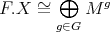 . Assume now that
  is a direct summand of
  . Let
. Let  and
and  be such that
  . We get morphisms
  and
and  which yield a pair of maps
 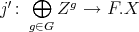 and
and 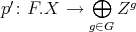 . Since
  for
for  , then the endomorphism
  of
of  is invertible.
Since  induces an equivalence of categories
  , then
  is a direct summand of
  . Thus
  .
.
(2): Let  . By the proof of (1),
  where
where  . Then we have to show that an indecomposable direct summand
  of
of  is weakly
  -periodic. Indeed, let
  be a set of representatives of the cosets of
  with respect to
  . Then
  is a direct summand of
  . Since
  is contained in a finite number of
  -orbits, then
  is finite. The converse follows from (1). □
5.4. A category  is called locally support finite if for each
  , the full subcategory
  of
of  , consisting of the vertices of all
  with
with  and
and  , is finite.
- Proposition.
- Let
 be a Galois covering. Then
 - If
 acts freely on
  , then
  induces a bijection
  .
. - If
 is locally support finite, then
  . In particular if
  acts freely on
  , then
  induces a bijection between
  and
and  . Moreover, in this case
  is tame (resp. domestic, poynomial growth) if and only if so is
  . For the Auslander-Reiten quivers we have
  .
.
- If
Proof. (a): Follows from (4.2) since there are no weakly  -periodic indecomposable
  -modules.
(b): Let  and consider
  with
with  . Let
. Let  be the (finite) full subcategory of
  consisting in the objects
  such that
  or
or  for some
  . Let
. Let  be an indecomposable direct summand of the restriction
  such that
  . Hence
  and it is easy to check that
  is a direct summand of
  in
in  .
.
Thus  . The last claim is easy to prove. □
- Example:
- The category
 given by the quiver with relations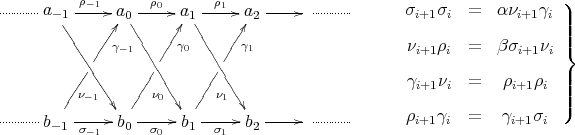
 , is locally support finite (why?). Moreover the group
  generated by the action
  acts freely on
  and on
  . Hence the Galois covering
  yields a bijection
  . The algebra
  is given by the quiver with relations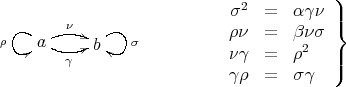
 is tame (resp. polynomial growth for
  ), so is
  .
.
5.5. Given a natural number  , a group
  is said to be
  -residually finite if for each finite subset
  there is a normal subgroup of finite index
  such that
  and
and  . For example, free groups are
  -residually finite.
- Theorem [12].
- Let
 be a Galois covering given by the action of a
  -residually finite group
  , where
  . Assume that
  is locally support finite. Then
  is tame if and only if
  is tame.
Proof. Without loss of generality, we assume that  is finite. We denote also by
  the induced covering functor. We divide the proof in several steps.
(1) Let  be the push-down functor. Consider a sequence
  of finite full subcategories of
  such that
  and if
  or
or  , then
  . The restriciton functor
  has a left adjoint
  such that
  . Therefore, the functor

 .
. (2) Let  , we shall prove that
  is a direct summand of
  . Indeed, since
  is locally support-finite, by (5.3), the pull-up
  decomposes as
  , where
  . Thus
 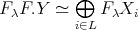 . We proceed in two steps.
(2.1) There exists a normal subgroup  of
of  with finite index not divisible by
  , such that the Galois covering
  induces a bijection
  .
.
Since  is finite, the set of vertices of
  is a disjoint union of a finite number of
  -orbits
  ,
,  . With the notation introduced above, we consider the full subcategory
  , of
, of  . Let
. Let  be the set of all elements
  such that
 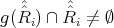 , for some
  . Since
  acts freely on
  , then
  is finite and there is a normal subgroup
  of
of  such that
  is finite of order not divisible by
  and
and  . Hence
  ,
,  . By (5.1), the induced Galois covering
 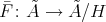 yields an injection
  . We show that this map is also surjective. Let
  and
and  a vertex of
  such that
  . The restriction
  is a bijection and there is an indecomposable
  -module
  with
with  and such that
  is an indecomposable direct summand of the restriction
  of
of  to
to  . We conclude that
  and
and  , showing that
  .
.
(2.2) For the proof of (2), consider a normal subgroup  of
of  as in (2.1) and a factorization of Galois coverings
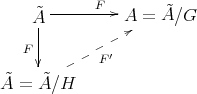
 and
and  . For an indecomposable
  , we get
 with
with  for
for  . Then
  and the result follows from (4.2). In particular,
  is a direct summand of
  for some
  .
. (3) There is some  and a function
  such that

 with
with  , there exists some
  with
with  and such that
  is a direct summand of
  .
. Indeed, the set of vertices  is the disjoint union
  , then there is some
  such that
  contains all the categories
  for
for  ,
,  . By (2),
  is a direct summand of
  for some
  . For some
  ,
,  and
and  satisfies that
  is a direct summand of
  . Clearly,
  (where
  denotes the number of objects of
  ) satisfies the desired property.
(4) Assume that  is tame, we show that
  is tame. Indeed, let
  and
and  be as in (3). Since
  is right exact (1), there is a
  -bimodule
  such that
  . Let
. Let  .
.
Since  is tame, there is a family
  of
of ![Γ n - k[T ]](/img/revistas/ruma/v48n2/2a02987x.png) -bimodules which are finitely generated free as
-bimodules which are finitely generated free as ![k[T]](/img/revistas/ruma/v48n2/2a02988x.png) -right modules and such that any indecomposable
-right modules and such that any indecomposable  -module
  with
with  is isomorphic to
 ![Mi ⊗k[T] S](/img/revistas/ruma/v48n2/2a02992x.png) for some
for some  and
and  a simple
 ![k[T]](/img/revistas/ruma/v48n2/2a02995x.png) -module. By (3), for every
-module. By (3), for every  with
with  , there exists some
  and
and  a simple
 ![k [T ]](/img/revistas/ruma/v48n2/2a021000x.png) -module such that
-module such that  is a direct summand of
 ![(N ⊗ Γ n Mi ) ⊗k[T] S](/img/revistas/ruma/v48n2/2a021002x.png) . It is easy to see that this (aparently) weaker property is equivalent to the tameness of
. It is easy to see that this (aparently) weaker property is equivalent to the tameness of  .
.
(5) Assume now that  is tame. It is enough to show that each
  is tame. Consider the right exact functors

 . Thus
  and
and 
 is the finite set of
  such that
  . As in (3), (4) we get that
  is tame. □
 5.6. We consider several examples:
(a) Let  be a Galois covering induced from a Galois covering of quivers with relations and defined by the action of a group
  . Assume that
  is locally support-finite.
- If
 is a finite group such that
  does not divide the order of
  , then (5.5) applies and
  is tame if and only if so is
  .
. - If
 is a free group, then both (5.2) and (5.7) apply.
(b) Consider example (5.4). For  , the category
  is tame and locally support finite. Hence the algebra
  is tame.
(c) [8] Consider the Galois covering

 . We know that
  is tame. We show that
  is a wild algebra.
 Set  ,
,  ,
,  ,
,  . Then
  is isomorphic to the algebra
  given by the quiver with relations.

 constructed as in (2.3) admits a full convex subcategory
  as follows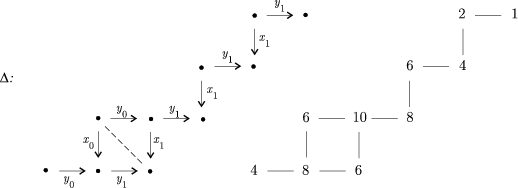
Since  is wild (observe that the Tits form
  takes value
  in the indicated vector), then
  is wild. Then
  is also wild.
(d) The algebra  of example (c) provides another example of a wild algebra whose Tits form
  is weakly non-negative. Indeed,

5.7. We consider briefly the situation of coverings  where
where  is not necessarily locally support-finite.
Let  be a Galois covering. A line in
  is a full convex subcategory isomorphic to the path category of a linear quiver (of type
  ,
,  or
or  ). A line
  is
is  -periodic if its stabilizer
  is non-trivial (then
  is of type
  ).
).
Let  be a
be a  -periodic line in
  , we construct an indecomposable weakly
  -periodic
  -module
  by setting
  for
for  and
and  for
for  and
and  for any arrow
  in
in  . Then
  is isomorhic to
  . Let
. Let  be a set of representatives of the
  -orbits in
  , for any object
  in
in  . Then
  is a
is a ![A ∕G - k[T, T -1]](/img/revistas/ruma/v48n2/2a021083x.png) -bimodule such that for each
-bimodule such that for each  ,
,  is a free
 ![k[T, T -1]](/img/revistas/ruma/v48n2/2a021086x.png) -module of rank
-module of rank 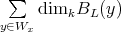 . We consider the functor
![φL = FλBL ⊗k[T,T- 1] (- ): modk [T,T-1] → modA ∕G.](/img/revistas/ruma/v48n2/2a021088x.png)
 be the set of all lines in
  and
and  be the set of representatives of the
  -orbits in
  .
. - Theorem [5].
- Let
 be a Galois covering such that
  acts freely on
  . Assume that for any weakly
  -periodic
  -module
  ,
,  is a line. Then
 - Every module in
 is of the form
  for some
  and some indecomposable
 ![k [T, T- 1]](/img/revistas/ruma/v48n2/2a021104x.png) -module
-module  .
. ![Γ = Γ ∕G ∨ ∨ Γ -1 A∕G A L∈L0 k[T,T ]](/img/revistas/ruma/v48n2/2a021106x.png) , where
, where ![Γ k[T,T-1]](/img/revistas/ruma/v48n2/2a021107x.png) is the translation quiver of finite dimensional indecomposable
is the translation quiver of finite dimensional indecomposable ![k[T,T -1]](/img/revistas/ruma/v48n2/2a021108x.png) -modules, consisting of a
-modules, consisting of a  -family of stable tubes of rank one.
 is tame if and only if so is
  .
. 
- Every module in
[1] M. Beattie. A generalization of the smash product of a graded ring. J. Pure Appl. Algebra 52 (1988) 219-229. [ Links ]
[2] K. Bongartz and P. Gabriel. Covering spaces in Representation Theory. Invent. Math. 65 (3) (1982) 331-378. [ Links ]
[3] O. Butscher and P. Gabriel. The standard form of a representation-finite algebra. Bull. Soc. Math. France 111 (1983) 21-40. [ Links ]
[4] C. Cibils and E. Marcos. Skew categories. Galois coverings and smash product of a category over a ring. Preprint (2004). [ Links ]
[5] P. Dowbor and A. Skowronski. Galois coverings of representation infinite algebras. Comment. Math. Helv. 62 (1987) 311-337. [ Links ]
[6] P. Gabriel. Auslander-Reiten sequences and representation-finite algebras. In 'Representation of Algebras', Springer LNM 831 (1975) 1-71. [ Links ]
[7] P. Gabriel. The universal cover of a representation-finite algebra. In 'Representation of Algebras'. Springer LNM 903 (1981) 68-105. [ Links ]
[8] Ch. Geiss and J. A. de la Peña. An interesting family of algebras. Archiv. Math. 60 (1993) 25-35. [ Links ]
[9] R. Martínez-Villa and J. A. de la Peña. The universal cover of a quiver with relations. J. Pure and Appl. Algebra 30 (3) (1983) 277-292. [ Links ]
[10] R. Martínez-Villa and J. A. de la Peña. Automorphisms of representation-finite algebras. Invent. Math. 72 (1983) 359-362. [ Links ]
[11] J. A. de la Peña. Symmetries of quivers and the Coxeter transformation. J. Algebra 169 (1994) 200-215. [ Links ]
[12] J. A. de la Peña. Tame algebras: some fundamental notions. Ergänzungsreihe 95-010 (1995) Universität Bielefeld. [ Links ]
[13] Ch. Riedtmann. Darstellungsköcher, Überlagerungen und zurück. Comment. Math. Helv. 55 (1980) 199-224. [ Links ]
J. A. de la Peña
Instituto de Matemáticas, UNAM.
Circuito Exterior.
Ciudad Universitaria.
México 04510, D. F. México
jap@matem.unam.mx
Recibido: 6 de octubre de 2006
Aceptado: 3 de junio de 2007

