



Servicios Personalizados
Revista

Articulo
 Inglés (pdf)
 Articulo en XML
 Referencias del artículo
 Traducción automática
 Enviar articulo por email
Indicadores
-
 Citado por SciELO
Links relacionados
-
 Similares en
SciELO
Similares en
SciELO
Compartir

 Permalink
Revista de la Unión Matemática Argentina
versión impresa ISSN 0041-6932
Rev. Unión Mat. Argent. vol.50 no.1 Bahía Blanca jun. 2009
Simultaneous approximation by a new sequence of Szãsz-beta type operators
Ali J. Mohammad and Amal K. Hassan
Abstract. In this paper, we study some direct results in simultaneous approximation for a new sequence of linear positive operators  of Szãsz-Beta type operators. First, we establish the basic pointwise convergence theorem and then proceed to discuss the Voronovaskaja-type asymptotic formula. Finally, we obtain an error estimate in terms of modulus of continuity of the function being approximated.
Key words and phrases. Linear positive operators; Simultaneous approximation; Voronovaskaja-type asymptotic formula; Degree of approximation; Modulus of continuity.
In [3] Gupta and others studied some direct results in simultaneous approximation for the sequence:

where  ,
,  and
and  . After that, Agrawal and Thamer [1] applied the technique of linear combination introduced by May [4] and Rathore [5] for the sequence
  . Recently, Gupta and Lupas [2] studied some direct results for a sequence of mixed Beta-Szãsz type operator defined as
  .
.
In this paper, we introduce a new sequence of linear positive operators  of Szãsz-Beta type operators to approximate a function
  belongs to the space
  , as follows:
 | (1.1) |
We may also write the operator (1.1) as  where
where  ,
,  being the Dirac-delta function.
The space  is normed by
  .
.
There are many sequences of linear positive operators with are approximate the space  . All of them (in general) have the same order of approximation
  [6]. So, to know what is the different between our sequence and the other sequences, we need to check that by using the computer. This object is outside our study in this paper.
Throughout this paper, we assume that  denotes a positive constant not necessarily the same at all occurrences, and
 ![[β ]](/img/revistas/ruma/v50n1/1a0419x.png) denotes the integer part of
denotes the integer part of  .
.
For  the Szãsz operators are defined as
  ,
,  and for
  (the set of nonnegative integers), the
  -th order moment of the Szãsz operators is defined as
  .
.
LEMMA 2.1. [3] For  , the function
  defined above, has the following properties:
(i)  , and the recurrence relation is

(ii)  is a polynomial in
  of degree at most
 ![[m ∕2]](/img/revistas/ruma/v50n1/1a0433x.png) ;
;
(iii) For every ,
,![( - [(m+1)∕2]) μn,m (x) = O n](/img/revistas/ruma/v50n1/1a0435x.png) .
.
From above lemma, we get
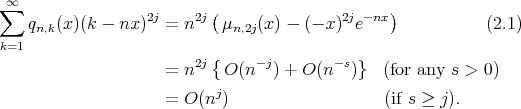
For  , the
, the  -th order moment
  for the operators (1.1) is defined as:

LEMMA 2.2.For the function  , we have
  ,
,  and there holds the recurrence relation:

Further, we have the following consequences of  :
:
(i)  is a polynomial in
  of degree exactly
  ;
;
(ii) For every ![x ∈ [0,∞ ) , T (x ) = O (n-[(m+1 )∕2]) n,m](/img/revistas/ruma/v50n1/1a0449x.png) .
.
Proof: By direct computation, we have  ,
,  and
and  . Next, we prove (2.2). For
  it clearly holds. For
  , we have

Using the relations  and
and 
 , we get:

By using the identity  , we have
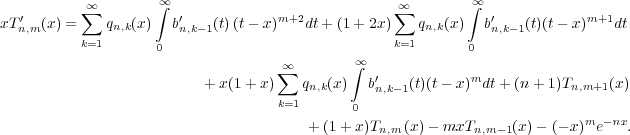
Integrating by parts, we get

from which (2.2) is immediate.
From the values of  and
and  , it is clear that the consequences (i) and (ii) hold for
  and
and  . By using (2.2) and the induction on
  the proof of consequences (i) and (ii) follows, hence the details are omitted.
From the above lemma, we have
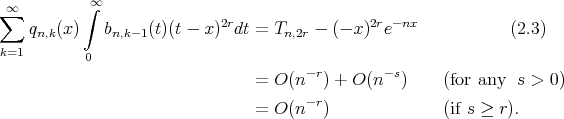
LEMMA 2.3. Let  and
and  be any two positive real numbers and
 ![[a,b] ⊂ (0,∞ )](/img/revistas/ruma/v50n1/1a0471x.png) . Then, for any
. Then, for any  , we have
![∥∥ ∥∥ ∥∥ ∫ ∥∥ ∥ Wn (t,x)tγdt ∥ = O (n- s). ∥∥ ∥∥ |t-x|≥δ C[a,b]](/img/revistas/ruma/v50n1/1a0473x.png)
Making use of Schwarz inequality for integration and then for summation and (2.3), the proof of the lemma easily follows.
LEMMA 2.4. [3] There exist polynomials  independent of
  and
and  such that
 where
where  .
.
Firstly, we show that the derivative  is an approximation process for
  .
.
Theorem 3.1. If  for some
  and
and  exists at a point
  , then
 | (3.1) |
Further, if  exists and is continuous on
  , then (3.1) holds uniformly in
 ![[a,b]](/img/revistas/ruma/v50n1/1a0488x.png) .
.
Proof: By Taylor's expansion of  , we have

where,  . Hence

Now, using Lemma 2.2 we get that  is a polynomial in
  of degree exactly
, for all  . Further , we can write it as:
 | (3.2) |
Therefore,

Next, making use of Lemma 2.4 we have
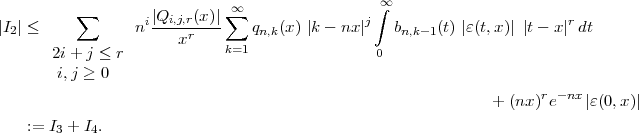
Since  as
as  , then for a given
  , there exists a
  such that
  , whenever
  . For
. For  , there exists a constant
  such that
  .
.
Now, since  . Hence,
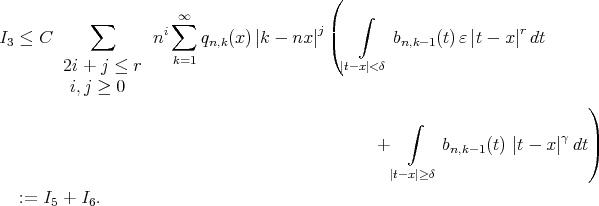
Now, applying Schwartz inequality for integration and then for summation, (2.1) and (2.3) we led to
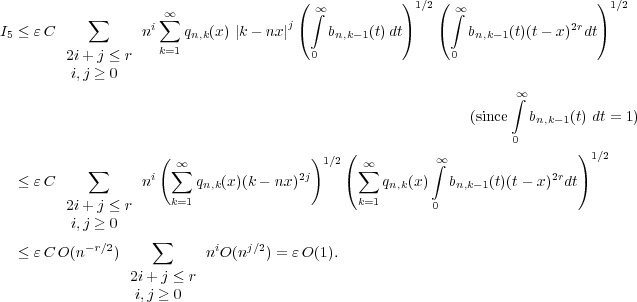
Again using Schwarz inequality for integration and then for summation, in view of (2.1) and Lemma 2.3, we have
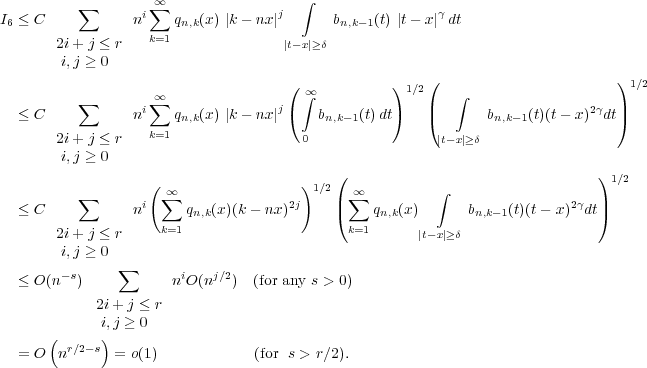
Now, since  is arbitrary, it follows that
  . Also,
  as
as  and hence
  , combining the estimates of
  and
and  , we obtain (3.1).
To prove the uniformity assertion, it sufficient to remark that  in above proof can be chosen to be independent of
 ![x ∈ [a,b]](/img/revistas/ruma/v50n1/1a04120x.png) and also that the other estimates holds uniformly in
and also that the other estimates holds uniformly in ![[a,b]](/img/revistas/ruma/v50n1/1a04121x.png) .
.
Our next theorem is a Voronovaskaja-type asymptotic formula for the operators  .
.
THEOREM 3.2. Let  for some
  . If
. If  exists at a point
  , then

Further, if  exists and is continuous on the interval
  , then (3.3) holds uniformly on
 ![[a,b]](/img/revistas/ruma/v50n1/1a04130x.png) .
.
Proof: By the Taylor's expansion of  , we get

where  as
as  .
.
By Lemma 2.2 and (3.2), we have
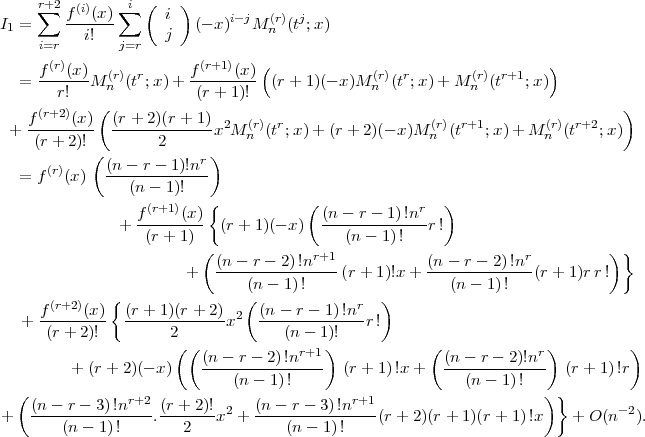
Hence in order to prove (3.3) it suffices to show that  as
as  , which follows on proceeding along the lines of proof of
  as
as  in Theorem 3.1.
The uniformity assertion follows as in the proof of Theorem 3.1.
Finally, we present a theorem which gives as an estimate of the degree of approximation by  for smooth functions.
THEOREM 3.3. Let  for some
  and
and  . If
. If  exists and is continuous on
  , then for sufficiently large
  ,
,
![∥ ∥ ∑q ∥ ∥ ( ) ∥∥M (nr)(f(t);x) - f(r)(x)∥∥ ≤ C1n -1 ∥∥f(i)∥∥ +C2 n-1∕2ωf(q) n-1∕2 +O (n-2) C[a,b] i=r C[a,b]](/img/revistas/ruma/v50n1/1a04147x.png)
where  are constants independent of
  and
and  ,
,  is the modulus of continuity of
  on
on  , and
, and ![∥ .∥C[a,b]](/img/revistas/ruma/v50n1/1a04154x.png) denotes the sup-norm on
denotes the sup-norm on ![[a,b]](/img/revistas/ruma/v50n1/1a04155x.png) .
.
Proof. By Taylor's expansion of  , we have

where  lies between
  , and
, and  is the characteristic function of the interval
  . Now,
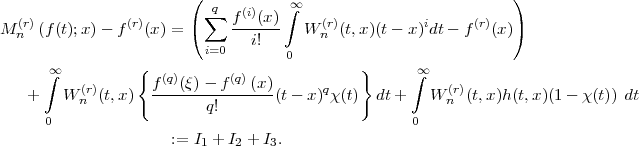
By using Lemma 2.2 and (3.2), we get

Consequently,
![( q ) - 1 ∑ ∥ (i)∥ -2 ∥I1∥C[a,b] ≤ C1n ∥f ∥C[a,b] + O (n ),uniformly on [a,b]. i=r](/img/revistas/ruma/v50n1/1a04164x.png)
To estimate  we proceed as follows:



![] r - nx q - 1 q+1 + (- n )e (x + δ x ) , δ > 0.](/img/revistas/ruma/v50n1/1a04169x.png)
Now, for  , using Schwartz inequality for integration and then for summation, (2.1) and (2.3), we have
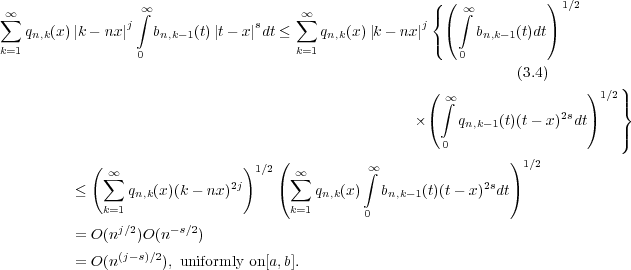
Therefore, by Lemma 2.4 and (3.4), we get
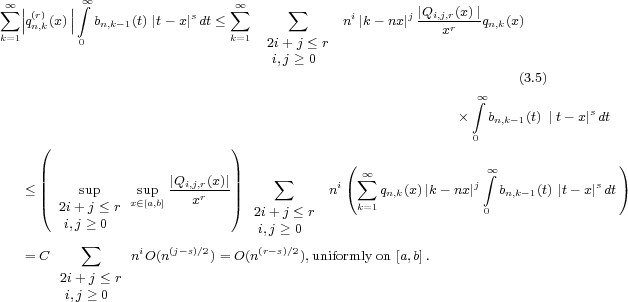
(since ![Q (x) sup sup |i,jx,rr--|:= M(x) 2i+ j ≤ r x∈[a,b] i,j ≥ 0](/img/revistas/ruma/v50n1/1a04173x.png) but fixed )
but fixed )
Choosing  and applying (3.5), we are led to

Since  , we can choose
  in such a way that
  for all
 ![x ∈ [a,b]](/img/revistas/ruma/v50n1/1a04179x.png) . Thus, by Lemmas 2.3 and 2.4 , we obtain
. Thus, by Lemmas 2.3 and 2.4 , we obtain
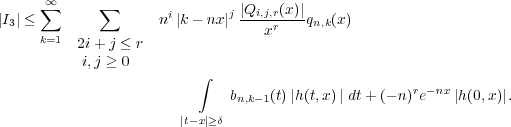
For  , we can find a constant
  such that
  . Hence, using Schwarz inequality for integration and then for summation ,(2.1), (2.3), it easily follows that
  for any
  , uniformly on
 ![[a,b]](/img/revistas/ruma/v50n1/1a04186x.png) .
.
Combining the estimates of  , the required result is immediate.
[1] P.N. Agrawal and Kareem J. Thamer. Linear combinations of Szãsz-Baskakov type operators, Demonstratio Math.,32(3) (1999), 575-580. [ Links ]
[2] Vijay Gupta and Alexandru Lupas. Direct results for mixed Beta-Szãsztype operators, General Mathematics 13(2), (2005), 83-94. [ Links ]
[3] Vijay Gupta, G.S. Servastava and A. Shahai. On simultaneous approximation by Szãsz-Beta operators, Soochow J. Math. 21, (1995), 1-11. [ Links ]
[4] C.P. May. Saturation and inverse theorems for combinations of a class of exponential- type operators, Canad. J. Math. 28 (1976), 1224-1250. [ Links ]
[5] R.K.S. Rathore. Linear Combinations of Linear Positive Operators and Generating Relations in Special Functions, Ph.D. Thesis, I.I.T. Delhi (India) 1973. [ Links ]
[6] E. Voronovskaja. Détermination de la forme asymptotique d'ápproximation des fonctions par les polynômes de S.N. Bernstein, C.R. Adad. Sci. USSR (1932), 79-85. [ Links ]
Ali J. Mohammad
University of Basrah,
College of Education,
Dept. of Mathematics,
Basrah, IRAQ.
alijasmoh@yahoo.com
Amal K. Hassan
University of Basrah,
College of Science,
Dept. of Mathematics,
Basrah, IRAQ.
Recibido: 8 de noviembre de 2006
Aceptado: 11 de marzo de 2008

